Learn Perfume Making at Home.
A premium beginner-friendly PDF that teaches fragrance structure, ingredient selection, blending ratios, and first formulas — with 52 material profiles, 6 formula studies, and a 64-term dictionary.
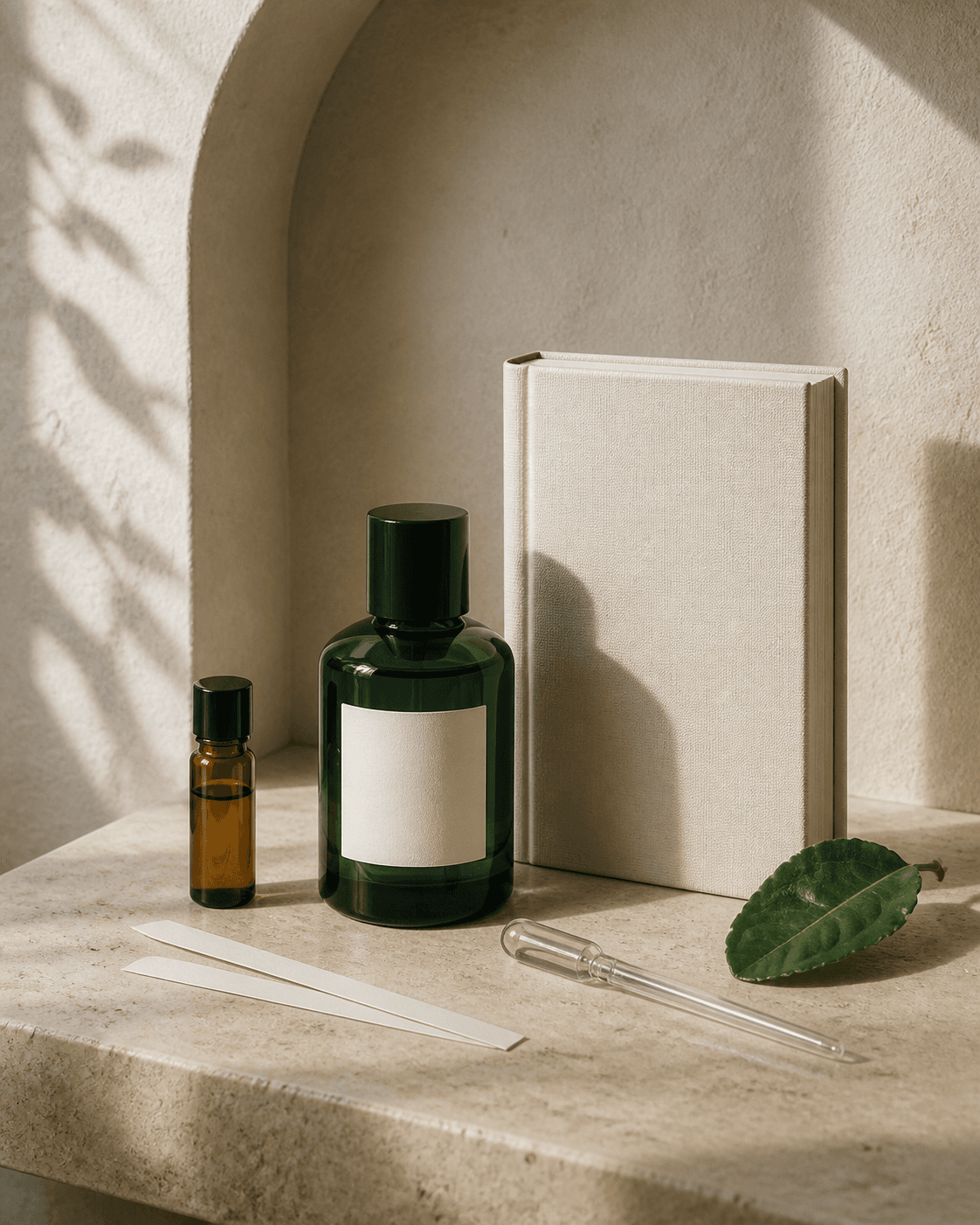
44 pages, built for the bench.
Start Safely & Set Up
Bench safety habits, a small studio built around accurate weighing, and a focused first purchase of six contrasting materials.
Structure, Families & Smelling
The fragrance pyramid and scent families, plus how to smell and compare materials on strips with consistent records.
Concentrations & Stocks
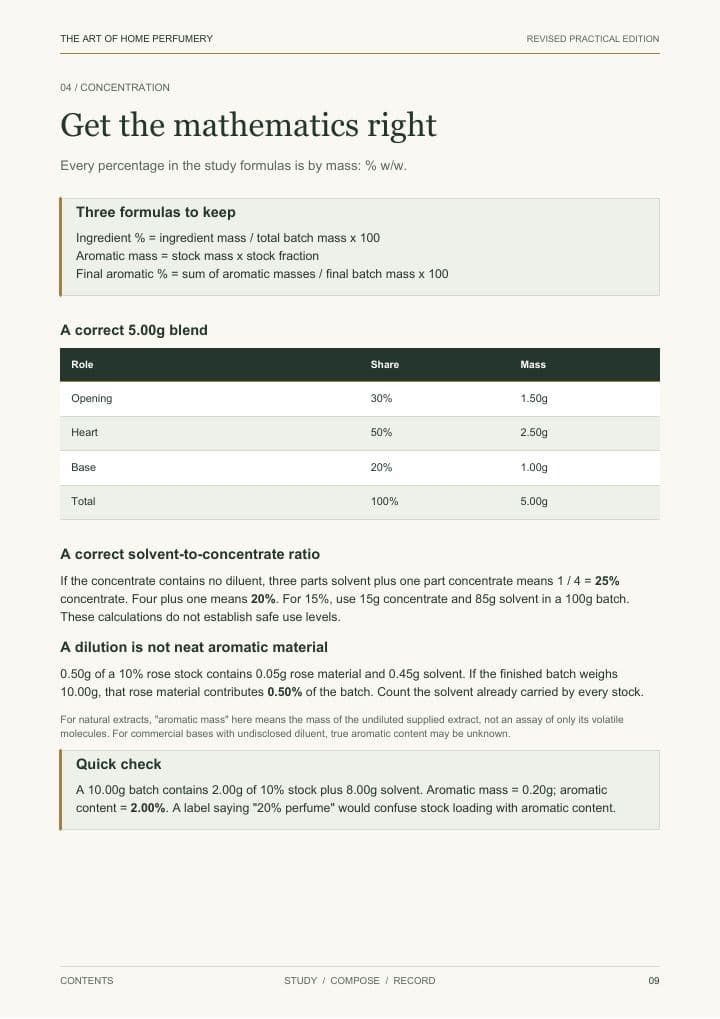
% w/w calculations, working stocks and labels, choosing a format, and reading supplier documents.
52-Material Palette
Four palettes with sensory direction and bench notes for each material, plus a practical order to expand your collection.
Accords & Improving a Blend
Build accords and improve a blend one controlled change at a time, instead of guessing.
Bench Workflow & Troubleshooting
A repeatable bench workflow, and how to troubleshoot with controlled experiments.
Six Formula Studies
Citrus Garden, White Floral Study, Cedar Atelier, Rose & Dark Woods, Citrus Fougère and Soft Amber.
Extraction, Storage & Records
Natural extraction, storing and checking your work, and three printable bench records.
Product, Labels & Business
Develop a product, prepare labels and packaging, and price and launch deliberately, with a compliance plan.
A fragrance is built on three tiers.
Always add oils in order — base first, then middle, then top. You will smell the fragrance build in real time.
Fifty ingredients, catalogued like a perfumer's organ.
| No. | Material | Family | Longevity on skin | Dilution | Reads as |
|---|---|---|---|---|---|
| 01 | Bergamot Citrus bergamia · Calabria | Top · Citrus | 0.4h | 10% | The opening of a thousand fougères. Bright, faceted, with a bitter rind that lifts heavier hearts. |
| 02 | Galbanum Ferula gummosa | Top · Green | 1h | 3% | Knife-green, bitter, cold. Sharpens citrus openings and makes florals read fresher. |
| 03 | Lavender Lavandula angustifolia | Heart · Herbal | 3h | 8% | Clean, camphorous, soft. The engine of the entire fougère family — and the perfect rose foil. |
| 04 | Rose de Mai Rosa centifolia · Grasse | Heart · Floral | 4h | 5% | Honeyed, dewy, slightly spicy. The backbone of classical florals — forgiving in any accord. |
| 05 | Jasmine Absolute Jasminum grandiflorum | Heart · White Floral | 6h | 3% | Indolic, narcotic, carnal. Pure opulence — a teaspoon too much will drown a composition. |
| 06 | Hedione Methyl dihydrojasmonate | Heart · Aromachem | 6h | 30% | The "jasmine enhancer". Transparent, airy, radiant. Adds diffusion without weight. |
| 07 | Sandalwood Santalum album · Mysore | Base · Wood | 10h | 10% | Creamy, lactonic, milk-soft. Harmonises everything it touches — the perfumer's universal solvent. |
| 08 | Oakmoss Evernia prunastri | Base · Mossy | 10h | 3% | Earthy, leathery, slightly inky. The defining base of chypre — use with IFRA awareness. |
| 09 | Iso E Super 7-acetyl hexamethyl tetralin | Base · Aromachem | 8h | 20% | Velvety cedar-amber. Present in over 50% of modern fine fragrances. Your radiance machine. |
| 10 | Ambroxan Clary sage derivative | Base · Aromachem | 12h | 10% | Dry, saline, skin-like amber. The "warm magnet" behind modern ambergris-style bases. |
| 11 | Labdanum Cistus ladanifer | Base · Resin | 12h+ | 2% | Leather, amber, warm smoke. The cornerstone of every amber and chypre base you will ever build. |
| 12 | Oud Aquilaria agallocha | Base · Animalic | 14h+ | 1% | Resinous, barnyard, medicinal. A divisive, tectonic base — a single drop recolours the entire accord. |
Six formula studies, weighed to the gram.
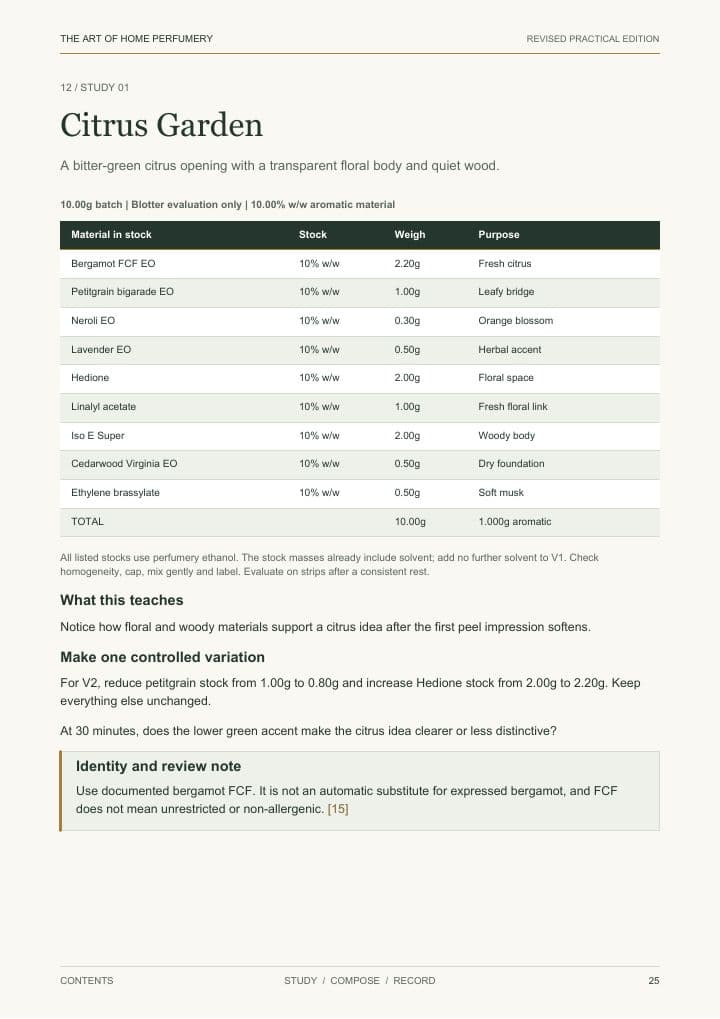
Citrus Garden
A bitter-green citrus opening with a transparent floral body and quiet wood.
White Floral Study
An airy floral composition with small rich-flower accents and a soft woody finish.
Cedar Atelier
Dry cedar over a smooth woody structure, with a restrained earthy shadow.
Rose & Dark Woods
A rosy heart against earthy woods and resin: an oud-adjacent creative direction.
Citrus Fougère
Lavender and citrus over hay-like warmth and a restrained mossy impression.
Soft Amber
A gentle resinous amber with a dry woody frame and measured vanilla sweetness.
Inside the Guide
Built like a modern perfumery field manual.
The guide combines fragrance theory, ingredient education, blending systems, aromachemicals, formula studies, and perfumery terminology into one structured digital reference designed for practical learning.
Ingredient Profiles
Learn how naturals and aromachemicals behave, evolve, and interact inside real perfume structures.
Formula Studies
Work through six weighed formula studies covering citrus, white floral, cedar, rose and dark woods, fougère and amber directions.
Perfume Structure
Understand top, middle, and base notes — and why perfumes change over time on skin.
Professional Terminology
Build confidence with a full perfumery glossary covering accords, drydown, fixatives, sillage, and more.
Real pages, made for the bench.
Clean tables, exact weights and printable records: read on any device or print for the bench.
Written for three kinds of maker.
The Beginner
You've never mixed a drop. Start with the safe-setup pages, smell three materials, and work through Study 01 on smelling strips, one weighed step at a time.
The Hobbyist
You blend most weekends and want to understand why your accords go muddy. The calculation lessons and controlled-experiment troubleshooting will rebuild your intuition, one change at a time.
The Artisan
You're ready to sell. The business roadmap covers product development, labels and packaging, pricing and launch, and the compliance planning to do before you sell.
Home Perfumery Guide
Learn perfume making at home with a guide built for real beginners and curious artisans.
The Home Perfumery Guide is a complete perfume guide and digital resource for anyone who wants to understand how to make perfume at home with more clarity, structure, and artistic confidence. Instead of piecing together random tutorials, readers get a focused learning path through fragrance materials, formula thinking, and practical application.
This perfume making eBook introduces the foundations of artisan perfumery, including the perfume pyramid, raw materials, formula construction, and the language used by perfumers. It is designed for beginners, hobbyists, creative makers, and anyone exploring a serious entry point into home perfumery.
Inside, you will find a curated look at 52 material profiles, 6 formula studies, and a 64-term dictionary that makes fragrance education easier to follow. The result is a guide that is both inspirational and practical, whether you are studying scent creation for the first time or refining your personal perfume experiments.
Learn More
Start with a beginner-friendly guide to making perfume at home.
New to perfumery? Read our practical introduction to making perfume at home before diving into the full guide.
A modern perfumery field manual for beginners.
Designed to help beginners understand fragrance structure, ingredients, accords, blending, and modern perfume construction — without overwhelming technical complexity.
The Home Perfumery Guide
- 44 pages: safety, calculations, blending and business
- 52 material profiles with bench notes
- Six complete formula studies with stock strengths and weights
- 64-term perfumery dictionary and sources directory
- Selling online — pricing & platforms
- 3 printable bench records for formula and batch tracking
- Beginner-friendly structure with practical explanations
Built to make modern perfumery understandable for beginners.
Most perfume education online is either too simplified to be useful or too technical for beginners to follow. This guide was created to bridge that gap — combining fragrance structure, ingredient knowledge, aromachemicals, blending methods, and real-world perfume construction into one practical system.
Instead of random DIY recipes, the goal is to help readers understand why perfumes smell balanced, how accords are built, how materials interact, and how modern fragrances are actually structured — so they can move from copying formulas to creating their own.