About Alaa Allam
The Home Perfumery Guide was created to give beginners a clear, structured path into the world of fragrance making — without the overwhelm, scattered tutorials, or overly technical language that makes most perfumery content hard to approach.
About the Author
I'm Alaa Allam — the writer and creator behind The Home Perfumery Guide. I've been studying fragrance seriously for over four years, not as a casual hobby but as a focused, methodical practice. What started with a single question — why does this perfume feel finished and mine always feels flat? — turned into years of working through fragrance materials one by one, building and evaluating formulas from scratch, and learning to read a composition the way a trained perfumer would.
Over that time I've created and tested more than twenty original formulas. I've worked through naturals — essential oils, absolutes, resins, CO₂ extracts — and modern aromachemicals including Ambroxan, Iso E Super, Hedione, and a range of musk molecules. Beyond the bench work, I've spent considerable time with supplier specification sheets, GC/MS reports, IFRA usage guidelines, and the kind of technical material that most beginner resources skip because it's assumed to be too advanced. I don't think that's the right assumption. Understanding why a material behaves the way it does — its volatility, its safe usage thresholds, how it changes at different dilutions — is what separates confident formulation from guesswork.
What I found, working through the available resources, is that most beginner perfumery content falls into one of two failure modes: it's either too superficial — vague descriptions of notes with no real formulation thinking — or too advanced, aimed at people already working professionally in the industry. There was very little in between. No resource that was structured, honest, and genuinely practical for someone who is serious about learning but starting from zero.
The Home Perfumery Guide is my attempt to fill that gap. It's built around what I actually needed to know in the first year: how the fragrance pyramid works as a formulation tool rather than just a descriptive framework; how to evaluate and pre-dilute materials before committing them to a blend; how to read an ingredient's character across different concentrations; and how to build a composition that holds together across its full dry-down arc. The six formula studies in the guide are newly authored educational starting points with checked arithmetic, built for smelling-strip evaluation and designed to teach the thinking behind them, not just the measurements.
I wrote it because I wanted the resource I couldn't find when I started.
About the Guide
The Home Perfumery Guide is a 44-page digital PDF designed for beginners and curious makers who want to understand perfumery from first principles. It covers:
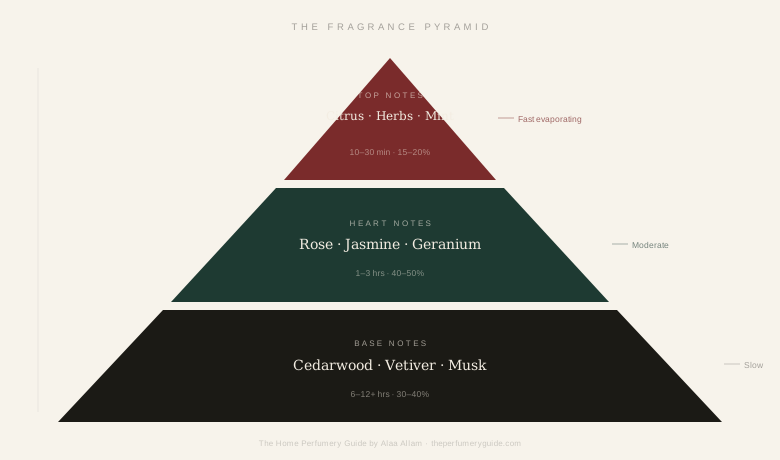
- The fragrance pyramid and how perfumes evolve over time
- 52 material profiles across naturals and aromachemicals, with bench notes
- 6 formula studies with stock strengths, weights in grams and a controlled variation each
- Safety, calculation lessons, dilution and blending guidance, and printable bench records
- A 64-entry terminology dictionary
It is designed to be both a learning resource and a practical bench reference — something you can read once to build your foundations and return to repeatedly while you are actually creating.
Articles
- How to Create Perfume at Home — Beginner Guide
- Perfume Ingredients Guide for Beginners
- Perfume Notes Explained: Top, Heart, Base Notes
Get in Touch
For questions about the guide or anything related to home perfumery, reach out at hello@theperfumeryguide.com.