Free Guides
Perfumery Guides for Beginners
By Alaa Allam · Updated
Practical, in-depth guides to help you understand fragrance making from the ground up — free to read before or alongside the full Home Perfumery Guide.
What You Will Learn
Home perfumery is one of the most technically and sensorially rewarding creative practices you can take up — and also one of the most misunderstood. Most beginners come to it with a simple question: how do I make something that smells like a real perfume? The honest answer is that it requires understanding three things simultaneously: the structure of a fragrance (how notes stack and evolve over time), the ingredients (what each material contributes and why), and the process (how to blend, evaluate, dilute, and macerate a formula).
These three guides cover each of those foundations in depth. They are free, written for beginners with no prior knowledge, and structured so that each one builds on the last. You can read them in order as a learning sequence, or dip into the one most relevant to where you are in your practice. If you want the full picture first, start with our complete home perfumery guide, which ties all three topics together.
Recommended Reading Order
If you are starting from zero, begin with Perfume Notes Explained. Understanding the fragrance pyramid — top notes, heart notes, and base notes — is the conceptual foundation everything else rests on. Once you know how the tiers work and why materials evaporate at different rates, you will be able to read a formula, evaluate a blend, and understand why a perfume smells the way it does at different points in time.
From there, read the Perfume Ingredients Guide. This covers the two main categories of fragrance materials — naturals (essential oils, absolutes, resins) and aromachemicals (synthetic aroma molecules like Ambroxan, Iso E Super, and Hedione) — and explains what role each plays in a composition. It includes a recommended beginner starter palette of 12 to 15 materials you can actually work with without overwhelming yourself.
Finally, the How to Make Perfume at Home guide walks through the full practical process: the equipment you need, how to pre-dilute materials, the step-by-step blending method, how to evaluate your blend on a strip and on skin, and how to macerate your finished formula. It also covers the most common beginner mistakes — starting with too many ingredients, skipping dilution, and evaluating too early — and how to avoid them.
Next: Recipes and Deeper Dives
Once the foundations click, the perfume making blog has hands-on projects and references: how to make perfume oil, a solid perfume recipe, the aroma chemicals list, a perfume concentration chart and what goes into cologne.
Who These Guides Are For
These guides are written for anyone who is curious about making perfume at home but does not know where to start. You do not need a background in chemistry or a professional perfumery education. You need a willingness to learn through your senses, some patience with the process, and a small focused set of fragrance materials to experiment with. The guides assume no prior knowledge — everything is explained from first principles.
They are also useful as supplementary reading if you have already started experimenting and are finding that your blends lack structure, fade too quickly, or do not develop the way you expected. Understanding why a fragrance behaves a certain way is the fastest route to fixing it.
10 min read
How to Make Perfume at Home
A complete step-by-step walkthrough for beginners — covering the equipment you need, fragrance structure, dilution, the blending process, maceration, and safety essentials.
9 min read
Perfume Ingredients List & Guide for Beginners
A complete fragrance ingredients list plus practical breakdown of natural materials and aromachemicals, organised by top, heart, and base note function — with a recommended beginner palette to start with.
8 min read
Perfume Notes Explained: Top, Heart & Base
Understand the fragrance pyramid — how top, heart, and base notes work together over time, what each tier contributes to a composition, and how to balance them in your own blends.
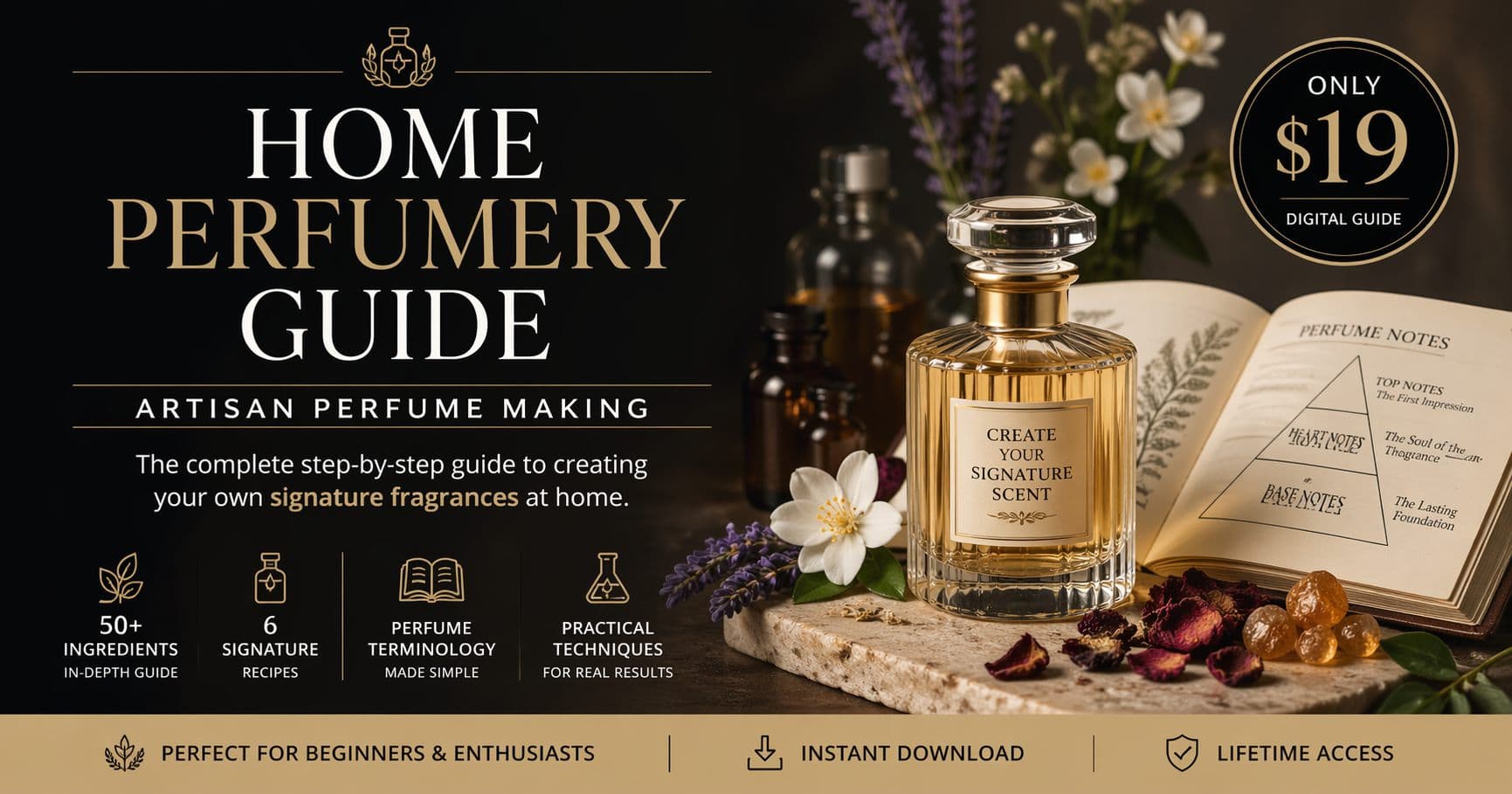
Want a complete structured path through home perfumery — with 52 material profiles, 6 formula studies, and a full 64-term dictionary?
Explore the Home Perfumery Guide →