How to Make Your Own Perfume at Home: Beginner Guide
By Alaa Allam · Published · Updated
Learning how to make your own perfume at home is more accessible than most people expect. You do not need a professional laboratory, expensive equipment, or years of formal training to start creating perfumes from scratch. With a focused set of materials, a basic understanding of fragrance structure, and a willingness to experiment, you can begin making your own perfume — on your kitchen bench, in your studio, or anywhere you have a clean workspace.
This guide walks you through everything a beginner needs to know: the tools, the ingredients, the structure of a fragrance, the step-by-step blending process, and the most common mistakes to avoid. By the end, you will have a clear path forward for your first formula.
What You Need to Start Home Perfumery
A functional home perfumery setup is inexpensive to assemble. The table below lists everything you need to start creating perfumes at home, followed by notes on each item.
| Item | Purpose | Notes |
|---|---|---|
| Aromatic materials | The building blocks of your perfume | Start with 10–15 focused ingredients — not more |
| Perfumers alcohol | Carrier and diluent for the finished formula | 190–200 proof ethanol; avoid rubbing alcohol |
| Glass vials or bottles | Test batches and finished formula storage | 10–30 ml amber or clear glass; never plastic |
| Droppers or pipettes | Precise, drop-level measurement | Disposable plastic pipettes; or 1–2 ml syringes |
| Smelling strips (blotters) | Evaluate materials and works-in-progress | Essential for accurate evaluation without skin contact |
| Labels and a notebook | Document every formula you create | No documentation = no reproducibility |
| Digital scale (optional) | Measure by weight for greater precision | 0.01g resolution; useful once you outgrow drop-counting |
| DPG or fractionated coconut oil (optional) | Pre-dilution carrier for potent materials | Alternative to alcohol for pre-diluting aromachemicals |
Essential Equipment
- Aromatic materials — essential oils, aromachemicals, absolutes, or resins. These are the building blocks of your fragrance. Start with a small focused set of 10 to 15 materials rather than buying a large collection at once.
- Perfumers alcohol (ethanol) — the carrier that dilutes and carries your fragrance. Look for high-purity perfumers alcohol (190–200 proof) or a denatured fragrance-grade ethanol. Avoid rubbing alcohol or isopropanol, which leave unwanted odours.
- Glass vials or bottles — 10 ml or 30 ml amber or clear glass bottles work well for small test batches. Glass is essential because plastic can interact with fragrance materials over time.
- Droppers or pipettes — disposable plastic pipettes allow precise measurement by drop. If you want greater precision early on, a set of small measuring syringes (1 ml, 2 ml) is also useful.
- Strips (smelling strips or blotters) — professional perfumers use paper smelling strips to evaluate materials and works-in-progress. They allow you to smell a material without skin contact and are essential for accurate evaluation.
- Labels and a notebook — record every formula you create. Perfumery without documentation is guesswork. Note the date, the materials, the drop counts, and your evaluation notes.
Optional but Useful
- A small digital scale (0.01g precision) for measuring by weight rather than drops
- A jewellers loupe or magnifying glass for reading small labels
- A dedicated fragrance storage box or drawer, away from heat and light
Understanding Perfume Structure: The Fragrance Pyramid and the 50/30/20 Rule
Before you blend anything, it helps to understand how a perfume is built. Fragrances are not a single smell — they are a layered, evolving composition that changes over time as different materials evaporate at different rates. This is described using the fragrance pyramid, which divides ingredients into three tiers.
The 50/30/20 rule in perfumery refers to the classic starting ratio for a balanced formula: roughly 50% heart notes, 30% base notes, and 20% top notes by proportion of your fragrance concentrate. These are not strict rules — some compositions are base-heavy (orientals, ouds) and others are top-heavy (fresh colognes) — but they give beginners a reliable starting point before developing their own instinct for balance.
Top Notes
Top notes are the first impression of a perfume. They are bright, fresh, and fast-evaporating, typically lasting 10 to 30 minutes after application. Common top note materials include bergamot, lemon, sweet orange, grapefruit, lime, petitgrain, and fresh herbs like basil or mint. Because they fade quickly, top notes create the opening character of the fragrance but do not represent its final identity.
Heart Notes (Middle Notes)
Heart notes form the core of the fragrance. They emerge once the top notes begin to fade and typically last one to three hours. The heart is where the personality of the perfume lives — florals, spices, fruity accords, green materials, and warm aromatic notes all tend to sit here. Examples include rose, jasmine, geranium, ylang-ylang, cardamom, cinnamon, black pepper, violet leaf, and iris.
Base Notes
Base notes provide depth, longevity, and the lasting impression of the fragrance. They are the slowest to evaporate — sometimes persisting for six hours or more on skin. Base notes include woods (cedarwood, sandalwood, vetiver), resins (labdanum, benzoin, frankincense), musks, vanillic materials, and modern aromachemicals like Ambroxan or Iso E Super. A strong base is what makes a perfume feel full and lasting rather than thin and short-lived.
Dilution: A Critical Concept Beginners Often Skip
Many beginner perfumers work with materials that are too concentrated and then wonder why their blends smell overwhelming or unbalanced. Most fragrance materials — especially aromachemicals and potent naturals — should be diluted before use.
A standard approach is to pre-dilute potent materials at 10% in alcohol or DPG (dipropylene glycol). This means mixing 1 part aromatic material with 9 parts carrier. Working with diluted materials gives you finer control over small amounts and makes it easier to smell individual characters without your nose being overwhelmed.
A typical finished perfume concentration (Eau de Parfum) contains roughly 15–20% of fragrance material dissolved in alcohol. For your first experiments, aiming for a lighter concentration — around 10–15% — is a sensible starting point while you are still learning how materials interact.
Step-by-Step: How to Make Perfume at Home
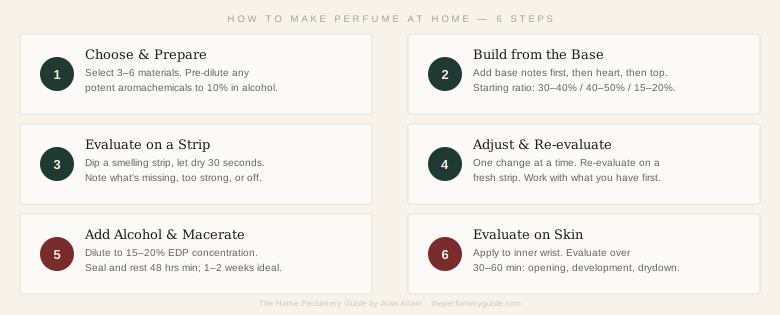
Step 1 — Choose and prepare your materials
Select three to six materials to work with: one or two base notes, one or two heart notes, and one top note. Starting with a very small palette keeps the composition manageable and helps you understand what each ingredient contributes. Pre-dilute any concentrated materials at 10%.
Step 2 — Build from the base
Most perfumers recommend building from the base upward. Add your base note materials first into a test vial, then layer heart notes on top, and finally the top notes. A rough starting ratio is: base 30–40%, heart 40–50%, top 15–20%. These are starting points — not rules — and you will adjust as you smell.
Step 3 — Evaluate on a strip
Dip a smelling strip into the vial and evaluate the accord on paper first. Let it dry for 30 seconds before smelling. The wet evaluation will be dominated by top notes; as the strip dries, heart and base notes emerge. Take notes on what you smell, what is missing, and what is too prominent.
Step 4 — Adjust and re-evaluate
Perfumery is iterative. If the blend smells too sharp, increase the base. If it smells flat or heavy, add a small amount of a brighter top note. Make one adjustment at a time and re-evaluate on a fresh strip. Resist the temptation to add new materials — work with what you have until the accord feels balanced.
Step 5 — Add alcohol and macerate
Once you are happy with your concentrate, dilute it in perfumers alcohol to your desired strength. For a basic Eau de Parfum, aim for 15–20% concentrate in alcohol. Seal the bottle, shake gently, and leave it to macerate in a cool dark place for at least 48 to 72 hours. Ideally, let it rest for one to two weeks before final evaluation. Macerating allows the materials to blend and marry, and many fragrances smell noticeably better after resting than they do freshly mixed.
Step 6 — Evaluate on skin
After macerating, spray or apply a small amount to your inner wrist and evaluate over 30 to 60 minutes. Pay attention to how it opens, how it develops, and what the drydown smells like. This is the real test — skin temperature, pH, and body chemistry will all affect how your fragrance behaves in ways that strips cannot replicate.
Safety: What Beginner Perfumers Need to Know
Some fragrance materials — particularly certain naturals like cinnamon bark, clove, bergamot (non-FCF), and oakmoss — are known skin sensitizers. Using them at high concentrations or without dilution can cause skin reactions, especially for people with sensitive skin. The IFRA (International Fragrance Association) publishes guidelines on safe usage levels for common materials, which are worth reviewing before using any new ingredient on skin.
General safety principles for home perfumers:
- Always dilute materials properly before skin application
- Patch test any new blend on a small area of skin before wearing it
- Work in a well-ventilated space — concentrated aromachemicals can be overpowering
- Store materials and finished perfumes away from heat, direct sunlight, and humidity
- Keep materials out of reach of children and label all containers clearly
Beginner Mistakes to Avoid
- Using too many ingredients at once. Blending ten or twelve materials before you understand any of them individually makes troubleshooting impossible. Start small.
- Ignoring dilution. Working with neat (undiluted) aromachemicals gives false impressions of their true character in a blend. Pre-dilute first.
- Skipping the rest period. A perfume evaluated fresh off the bench is not the same fragrance after a week of maceration. Patience is part of the process.
- Nose fatigue. After smelling several materials or blends in a row, your nose stops registering them accurately. Take breaks, smell coffee beans or fresh air to reset, and limit sessions to 30–45 minutes.
- No documentation. Every formula you create without recording it is a formula you cannot reproduce. Get into the habit of logging everything.
Want to go further?
The Home Perfumery Guide covers 52 material profiles, 6 complete formula studies, and a 64-term dictionary — a structured path from first principles to finished formula.
Get Instant Access · $9 →Your Next Steps in Home Perfumery
Creating your first blend is just the beginning. As you develop your nose and deepen your understanding of fragrance materials, you will find that perfumery becomes a genuinely absorbing creative practice — one that combines chemistry, artistry, and sensory education in equal measure. For the full picture of what this practice involves, see our complete guide to home perfumery.
To go deeper, explore our perfume ingredients guide for beginners — a practical breakdown of the materials you will use most often, including naturals, aromachemicals, and how to build your first palette. You may also find it helpful to read our guide to perfume notes, which covers how top, heart, and base notes interact in more detail.
Prefer a format without alcohol? Follow our recipes for how to make perfume oil with a carrier oil, or how to make solid perfume with a wax base.
Want a Complete System?
If you want a structured way to learn perfume creation — including 52 material profiles, 6 full formula studies, and real formulation thinking — the Home Perfumery Guide gives you a complete path from first principles to finished formula.