Perfume Notes Explained: Top, Heart, Base Notes Guide
By Alaa Allam · Published · Updated
If you have ever noticed that a perfume smells different the moment you spray it versus an hour later, you have already experienced perfume notes in action. Notes are not just a way of describing scent — they describe a process. They represent the layered, time-based evaporation of fragrance materials, each leaving the composition at a different rate and each contributing a different dimension to the overall experience.
Understanding how notes work is one of the most practical things a beginner can learn. It changes how you evaluate a perfume, how you choose materials, and how you approach building your own blends. This guide explains what each tier of the fragrance pyramid does, why it matters, and how to use it when you start creating.
What Are Perfume Notes?
Perfume notes are the individual scent impressions that emerge as a fragrance develops over time after application. Unlike music where all notes sound simultaneously, fragrance notes are sequential — each tier reveals itself as the previous one evaporates.
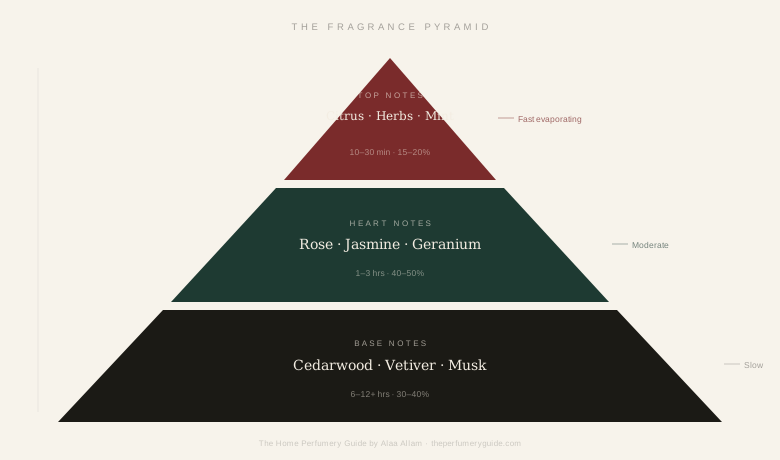
The concept is organised into a three-tier structure called the fragrance pyramid: top notes at the peak, heart notes in the middle, and base notes at the foundation. This structure was developed to help perfumers, critics, and consumers describe and understand how a fragrance unfolds from first contact to final drydown. Fragrantica’s encyclopedia of fragrance notes is a widely used public reference cataloguing how individual materials are classified and perceived across thousands of commercial fragrances.
It is worth noting that the pyramid is a simplified model, not a strict rule. In reality, many ingredients span multiple tiers, and the lines between notes are blurry. But as a mental framework for understanding fragrance composition and construction, it is extremely useful — especially for beginners.
Fragrance Notes Chart: Top, Heart & Base Notes at a Glance
The table below summarises all three note tiers — duration on skin, typical formula proportion, and the most common fragrance notes in each category.
| Note Tier | Duration on Skin | Formula % | Common Fragrance Notes |
|---|---|---|---|
| Top Notes | 10–30 minutes | 15–20% | Bergamot, Lemon, Sweet Orange, Grapefruit, Petitgrain, Lavender, Mint, Lime |
| Heart Notes | 30 min – 3 hrs | 40–50% | Rose, Jasmine, Geranium, Ylang-Ylang, Cardamom, Black Pepper, Iris, Violet Leaf, Cinnamon |
| Base Notes | 4–12+ hours | 30–40% | Cedarwood, Sandalwood, Vetiver, Patchouli, Benzoin, Labdanum, Ambroxan, Musk, Vanilla |
See the pyramid in a real formula
The chart tells you which notes go where. The Home Perfumery Guide shows six complete formulas built on it, with exact weights for every top, heart and base material.
Top Notes Explained
Top notes are the first things you smell when you apply a perfume. They are characterised by small, light, volatile molecules that evaporate quickly — typically within 10 to 30 minutes of skin contact. Their role in a fragrance is to create an immediate impression and invite the wearer (and any observer) in. They are the opening act, but they are not the main performance.
Because top notes fade so quickly, a common beginner mistake is to evaluate a perfume immediately after application and decide whether you like it based solely on what you smell in the first few minutes. A perfume with a challenging or underwhelming top note may have a beautiful heart and base — and the reverse is equally true.
Characteristics of top notes
- High volatility — they evaporate fastest of all three tiers
- Usually light, fresh, and immediately perceptible
- Typically represent 15–25% of a finished fragrance formula
- Last approximately 10 to 30 minutes after application
Common top note ingredients
- Bergamot — the most refined of the citrus top notes. Bright, slightly floral, with a delicate green-tea quality in the drydown. Used in countless classic colognes and modern fragrances.
- Lemon — sharp, clean, and instantly recognisable. Adds immediate freshness but evaporates very quickly.
- Sweet orange and grapefruit — rounder and more casual than lemon. Grapefruit adds a subtle bitterness.
- Petitgrain — extracted from the leaves of the bitter orange tree, it has a woody-green citrus character that bridges top and heart more effectively than most citrus.
- Lavender — technically an aromatic, not a citrus, but lavender frequently opens a fragrance before transitioning into a supporting heart role.
- Mint — cool, sharp, and clean. Used sparingly in fresh and aquatic openings.
Heart Notes Explained
Heart notes, also called middle notes, are the soul of the fragrance. Once the top notes fade, the heart becomes dominant and defines the character and direction of the composition. If a perfume is described as a floral, an oriental, a fougère, or a chypre — that identity lives in the heart.
Heart notes are made from molecules with moderate volatility. They typically emerge within 10 to 20 minutes of application as the top notes evaporate, and they remain perceptible for one to three hours. A well-built heart should feel like the natural, inevitable continuation of the opening — not a jarring shift.
Characteristics of heart notes
- Moderate volatility — they evaporate slower than top notes but faster than base notes
- Define the fragrance family and personality (floral, spicy, green, fruity, etc.)
- Usually represent 40–50% of a finished fragrance formula
- Last approximately 30 minutes to 3 hours after application
Common heart note ingredients
- Rose absolute or essential oil — the most used floral in perfumery. Rose absolute is rich, warm, and complex; rose essential oil is fresher and more transparent.
- Jasmine absolute — warm, indolic, and full-bodied. A cornerstone of Oriental and floral oriental structures.
- Geranium — a rosy-green aromatic that bridges florals, fougères, and fresh compositions. Highly versatile and beginner-friendly.
- Ylang-ylang — intensely sweet and tropical. Powerful at full strength — dilute to 10% before use. IFRA safety standards set usage limits for ylang-ylang in leave-on skin products due to its sensitisation potential.
- Cardamom — spicy, slightly eucalyptic, and dry. A popular modern heart note that adds warmth without heaviness.
- Black pepper — sharp, diffusive, and dry. Adds character and lift to both spicy and fresh compositions.
- Iris / Orris — powdery, violet-like, and extremely refined. A classic heart note in chypre and classic feminine structures.
Base Notes Explained
Base notes are the foundation of a fragrance. They are composed of large, heavy molecules with low volatility — meaning they evaporate very slowly, often persisting on skin for six hours or more. Base notes are what gives a perfume its longevity, depth, and lasting impression. They are also the tier that makes a fragrance feel expensive and complete rather than thin and fleeting.
In the initial application of a perfume, base notes are often barely perceptible — they are overshadowed by the brightness of the top notes and the identity of the heart. But as the fragrance develops and the lighter materials evaporate, the base gradually emerges. The drydown — the final dry, skin-close stage of a perfume — is almost entirely base notes.
Characteristics of base notes
- Low volatility — they evaporate slowest of all three tiers
- Provide longevity, depth, and the drydown character of the fragrance
- Usually represent 30–40% of a finished fragrance formula
- Can last 4 to 12+ hours after application depending on the material and skin chemistry
Common base note ingredients
Base note materials are characterised by their large molecular weight and low vapour pressure — properties you can explore for specific compounds via the Good Scents Company database, which lists boiling point, vapour pressure, and odour threshold data for most aromatic materials.
- Cedarwood (Atlas or Virginian) — dry, woody, and clean. One of the easiest base materials for beginners to work with.
- Sandalwood — creamy, milky, and smooth. Extremely useful as a base anchor that blends easily without overpowering other materials.
- Vetiver — smoky, earthy, and complex. Rooty and distinctive — best used sparingly until you understand its character.
- Patchouli — dark, earthy, and sweet-musty. A defining base note in oriental, chypre, and modern woody structures.
- Labdanum — warm, resinous, and slightly animalic. A classic amber base material.
- Benzoin and vanilla-type materials — sweet, warm, and balsamic. These create the soft, comforting quality in oriental and gourmand compositions.
- Ambroxan — a modern aromachemical with a warm, skin-close, woody-ambergris character. Excellent longevity at small percentages (0.5–3%).
- Musks (Galaxolide, Habanolide) — clean, soft, and skin-scent-like. Used to extend longevity and give the fragrance a seamless, wearable quality.
Why the Balance Between Notes Matters
A fragrance that is heavily weighted toward top notes will feel bright and fresh initially, but disappointing — it will fade quickly and lack depth. A fragrance overloaded with base notes will feel heavy and suffocating from the first spray, with little development. The art of balancing the three tiers is at the core of perfumery.
Classic proportions for a beginner formula to experiment with:
- Top notes: 15–20% of the total concentrate
- Heart notes: 40–50% of the total concentrate
- Base notes: 30–40% of the total concentrate
These ratios are starting points, not formulas. Every fragrance direction has its own characteristic balance — a fresh cologne will typically be more top-note heavy than a deep oriental. Experiment, evaluate, and adjust.
How Notes Interact: Blending Across the Pyramid
In practice, the best perfumes do not have three separate, distinct layers that simply take turns. The most interesting fragrances create transitions — where materials from adjacent tiers bridge smoothly into each other. Geranium, for example, has qualities that connect both the top and heart tiers. Iso E Super spans heart and base. Petitgrain spans top and heart.
When you are building a formula, look for materials that can serve as connectors between tiers. These bridge materials are part of what makes a fragrance feel seamless and coherent rather than like three separate smells sitting next to each other.
How to Use Perfume Notes in Your Home Perfumery Practice
Note structure is just one part of building a home perfumery practice — see our complete guide for the full picture, from equipment to process.
- Choose one material per tier to begin. One base, one heart, one top. Blend them and evaluate the structure before adding complexity.
- Build and evaluate slowly. Add one new material at a time, evaluate on a strip, wait for it to dry, then evaluate again. Do not rush.
- Evaluate at multiple time points. Smell your blend immediately, after 15 minutes, after 1 hour, and on skin if possible. The fragrance you created will evolve — and so will your understanding of whether the note balance is working.
- Adjust the base first if longevity is weak. A fragrance that fades too fast almost always needs more base, not more top notes.
Want to go further?
The Home Perfumery Guide gives you a complete path — 52 material profiles, 6 formula studies with exact weights, and a 64-term dictionary to support your learning at every stage.
Going Deeper
Now that you understand the structure, the logical next step is learning the individual materials that populate each tier. Our perfume ingredients list and guide for beginners covers naturals, aromachemicals, and how to choose a starter palette. If you are ready to start blending, our step-by-step guide to creating perfume at home walks through the full process from setup to finished formula.
For a closer look at specific notes, see our aroma chemicals list of 40 synthetic materials and the citrus-led top notes used in classic cologne.
Want a Complete Perfume System?
If you want to go deeper into perfume structure, ingredients, and real formulation thinking with worked formula studies, the Home Perfumery Guide gives you a full framework — from fragrance theory through to six complete formula studies.